

The School of Medicine of the National and Kapodistrian University of Athens and the Department of Applied Medical Physics, under the scientific supervision of Professor Efstathios Efstathopoulos, participate in the European project ELISAH (European Linkage of Initiative from Science to Action in Health), implemented within the EU4Health programme. Research and healthcare institutions from Greece, Italy, Spain and Ukraine participate in the project, coordinated by the National Cancer Institute of Milan.
The objective of the project is to investigate factors influencing breast cancer risk, with particular emphasis on environmental, social and behavioural determinants.
The Urban Environment as a Public Health Determinant
Scientific evidence has shown that air pollution, traffic burden, the availability of green spaces and opportunities for physical activity are important determinants of public health. Green spaces can improve air quality, encourage physical activity and provide protection against environmental risks associated with chronic diseases and cancer.
One of the project’s objectives is to investigate the relationship between air pollution, urban greenery, road-network characteristics and socioeconomic indicators in order to identify areas where effective public-health interventions can be implemented.
Comparative Analysis Across European Cities
A comparative assessment was conducted across ten European cities with different geographic, socioeconomic and environmental characteristics, including the metropolitan area of Athens. The analysis included the mapping of green spaces, road-network density and air-pollution levels.
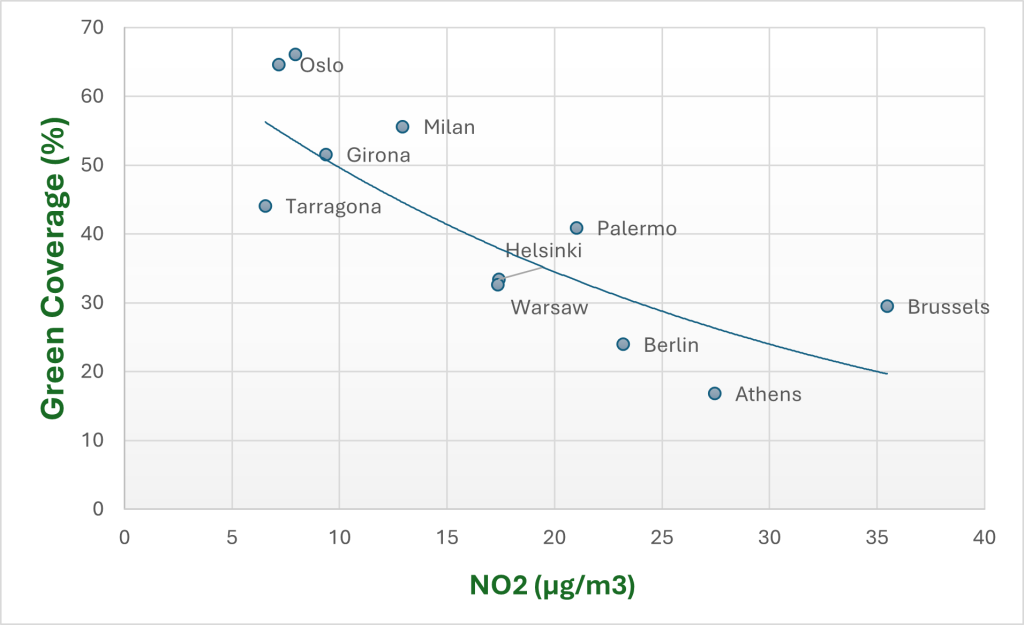
The results revealed significant differences among cities in terms of green-space coverage and pollution levels. Cities with a high road-network density tended to exhibit increased nitrogen dioxide (NO₂) concentrations, a widely used indicator of traffic-related pollution. In contrast, areas with more extensive green-space coverage showed lower NO₂ levels, supporting the important role of urban greenery in improving environmental quality.
Statistical analysis demonstrated a strong association between road-network density, NO₂ levels and green-space availability. Athens, Milan, Brussels and Paris were identified among the cities combining elevated NO₂ concentrations with limited green-space coverage, highlighting the need for targeted urban-planning interventions.
Neighbourhood-Level Analysis
A detailed neighbourhood-level analysis was performed for Athens, Milan and Ivano-Frankivsk (Ukraine), allowing spatial differences to be identified that are often not visible when only city-level averages are considered.
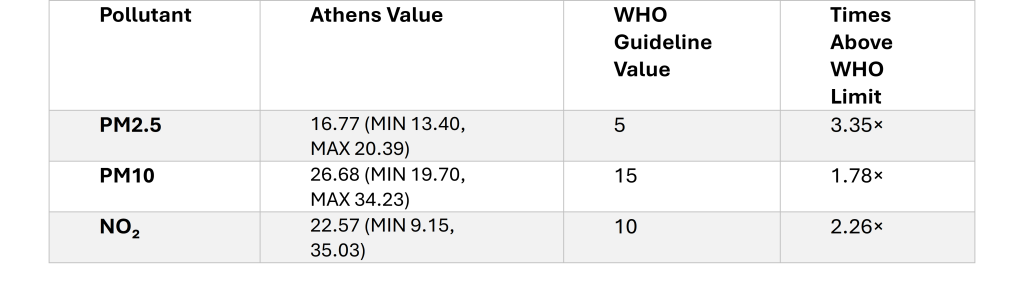
For Athens, the results showed that average concentrations of major air pollutants remain above World Health Organization guideline values. Significant differences were also observed among neighbourhoods regarding exposure to air pollution, availability of green spaces and sustainable-mobility infrastructure.
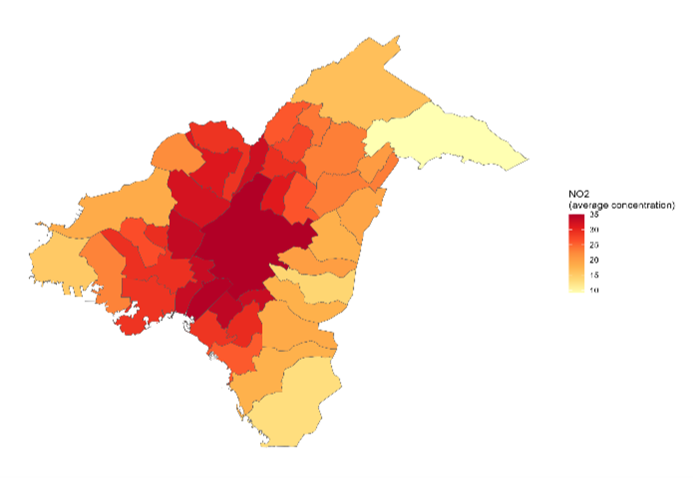
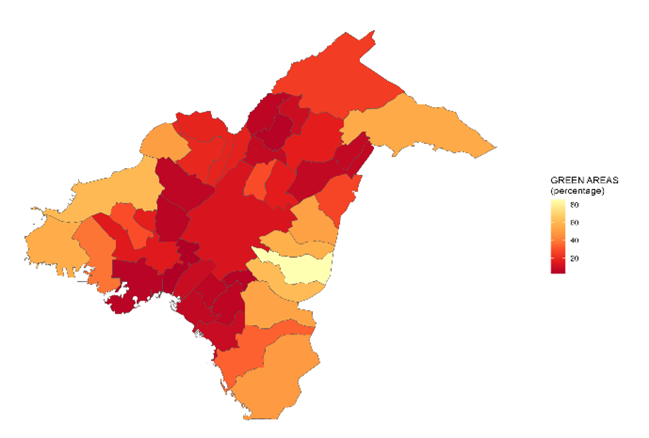
Analysis of socioeconomic data provided by the Athens Social Atlas showed that the most disadvantaged areas of Athens experience higher exposure to nitrogen dioxide (NO₂). This finding highlights the importance of incorporating environmental-justice considerations into public-health and sustainable urban-development policies.
Comparison with Milan demonstrated that socioeconomic inequalities are not expressed in the same way across all European cities. While disadvantaged neighbourhoods in Athens tend to have limited access to green spaces, similar areas in Milan often have greater availability of urban greenery. These findings underline the need for urban-planning policies tailored to the specific characteristics of each city.
The analysis also revealed significant differences among neighbourhoods regarding road-network density and the availability of sustainable-mobility infrastructure. Areas with higher densities of primary and secondary roads tended to experience higher levels of traffic-related pollution, demonstrating the importance of urban planning in shaping environmental exposure.
Bicycle-lane infrastructure also showed considerable spatial variation, with Athens exhibiting an average bicycle-lane density of only 0.72 km/km². The development of safe cycling and active-mobility infrastructure could help reduce traffic-related emissions while increasing physical activity, a factor associated with improved public health and reduced risk of chronic diseases.

These findings gain additional significance in light of recent ELISAH project results presented at an international scientific meeting. In a multicentre study involving more than 119,000 women with breast cancer from Greece, Italy, Spain and Ukraine, the majority of participants were exposed to air-pollution levels exceeding World Health Organization recommendations.
Furthermore, exposure to nitrogen dioxide (NO₂), a marker of traffic-related pollution, was associated with an increased risk of mortality, highlighting the importance of reducing air pollution in order to protect public health.
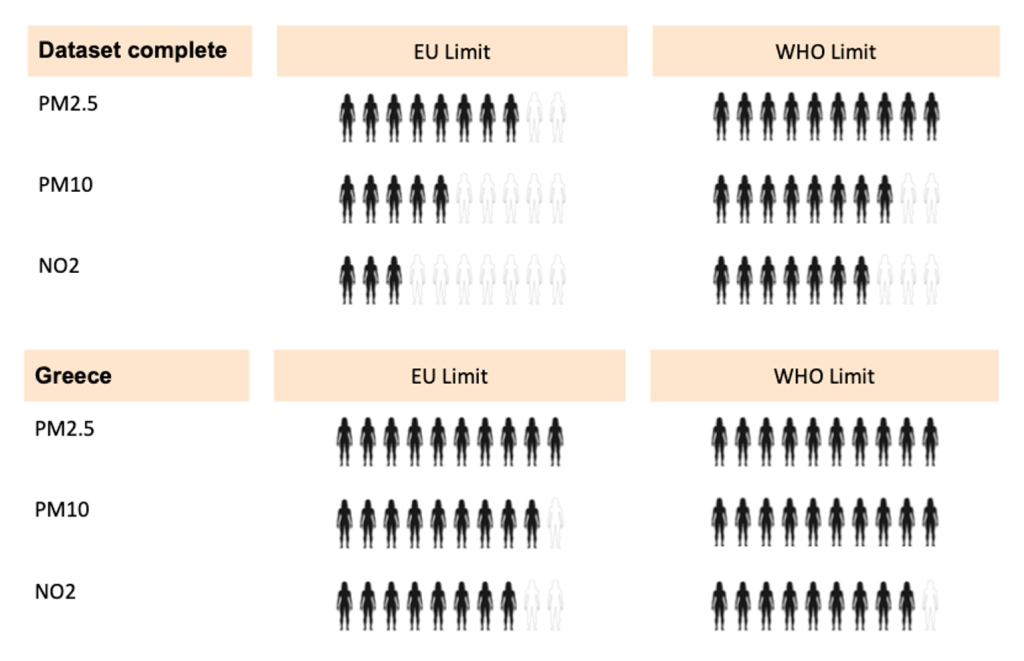
These findings emphasize the importance of the urban environment as a determinant of health. Expanding green spaces, reducing traffic-related pollution and promoting sustainable modes of transport can substantially improve quality of life while reducing environmental and social inequalities.
The ELISAH project provides scientifically validated evidence that can support the design of effective interventions at both local and European levels, contributing to the development of healthier and more sustainable cities.