
Development of advanced portable biophotonic system for the personalized spectroscopic distrimination of cancer margins/tissues
Co‐financed by the European Regional Development Fund of the European Union and Greek national funds through the Operational Program Competitiveness, Entrepreneurship and Innovation, under the call RESEARCH – CREATE – INNOVATE (project code:Τ2EDK-01223). Participants: School of Applied Mathematics and Physical Sciences of NTUA, Department of Medical Sciences of the Democritus University of Thrace (DUTH), School of Medicine of the University of Athens (NKUA) and Alpha Informatics SA Coordinator: Assoc. Professor Athanasios Kontos (NTUA), Scientific Responsible: Professor Maria Lambropoulou (DUTH)
Main goal
The proposed project BIOFASMA aims on the development and the pilot studies of a novel biophotonic system for the personalized diagnosis in open surgery of cancer structures/cells in the colon and rectum system. Its operation will be based on the in vivo acquisition, collection and analysis of the biostructure’s spectral fingerprints, using Raman spectroscopy to distinguish the healthy form the malignant margins in microscopic scale and in real time.
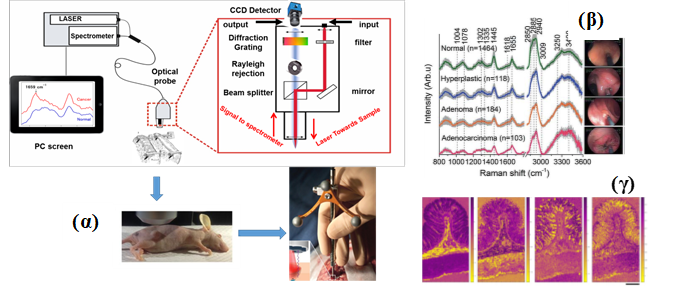
The BIOPHASMA project will develop an advanced biophotonic tool for the personalized rapid diagnosis in open surgery of cancer structures/cells of the colon and rectum in order to provide solutions to clinical needs. Its operation will be based on the collection, recording and rapid analysis of the characteristic spectral imprints of biostructures with the technique of Raman spectroscopy for accurate discrimination of healthy boundaries / tissues from cancerous in real time. The Raman spectroscopy is a spectroscopic technique with high detection sensitivity and spatial resolution of few μm. The spectral fingerprint which is produced during laser-biostructure interaction is unique and characterizes the biostructure. Any biochemical alteration related to inflammatory or cancer state is reflected on the spectral fingerprint. In literature numerous studies can be found verifying the accuracy and the sensitivity of the technique, as a tool for the discrimination between healthy and malignant tissues/cells either in ex vivo or in vivo. However, there are no accessible and deficient. In addition, the major clinical difficulty of the in vivo delimitation of the smaller cancer nodules with high accuracy is still not well-determined and faced successfully.
Duration:
Site: https://biofasma.com/en/home-en/
